r/SubredditConflicts
Team: Data Sentinels

Why do we hate on r/ada ?

Pinned

Hi guys !

As y’all are specialists of conflicts between subreddits, I just wanted to ask why the r/ada subreddit receives so much hate by r/csmastudents? I mean I get that the class is hard, but is that reason enough to be at odds with them? How can we explain that? Does it originate from other subreddits maybe?

Thanks again for your answers in advance!

Hi u/benevolentstudent401!

Welcome to r/SubredditConflicts and thank you for this first post in our newly created subreddit!

We are delighted to see you take an interest in the conflictual and negative relationships between subreddits! In the following series of posts, we will present both why us at DataSentinels decided to create this subreddit as well as interesting facts about those negative links. And now here comes our thread!

About Subreddit Conflicts

Reddit is often described as a collection of separate communities, thousands of subreddits, each with its own culture, rules, and conversations. But these communities do not exist in isolation. They constantly reference one another, react to events elsewhere on the platform, and sometimes clash in very public ways.

One of the clearest traces of these interactions is the hyperlink. When a subreddit links to a post from another cotension between communities. mmunity, it is often doing more than just sharing content. In many cases, the link signals criticism, disagreement, or disapproval. These moments leave behind a visible footprint of tension between communities.

Here, we look closely at those negative links and what happens after they appear. We follow how conflicts begin, how they spread from one subreddit to another, and how long they tend to last. We also examine which communities play a central role in keeping conflicts alive, and whether classic ideas about alliances and rivalries hold up in this online setting.

What emerges is not a picture of Reddit as a platform locked in endless battles between opposing groups. Instead, the patterns suggest something quieter and more dynamic. Disagreements surface frequently, travel across community boundaries, and draw in new participants, but most of the time, they fade away just as quickly.

By tracing these interactions over time, we can better understand how conflict moves through Reddit: when it escalates, when it stalls, and why large-scale breakdowns are far less common than they might appear.

Disclaimer: Throughout this page, we use ‘conflict’ as shorthand for negatively framed cross-subreddit references. This includes criticism, mockery, and disapproval, not necessarily coordinated hostility or sustained antagonism

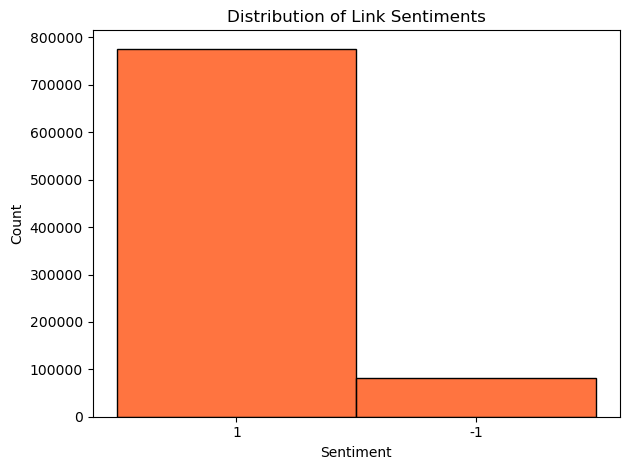
Distribution of Link Sentiments
Figure 1
Distribution of link sentiments

How to read the figure above: it gives the overall distribution of link sentiments, setting the baseline for everything that follows. The rest of the page focuses on the negative portion of that distribution, the links most associated with antagonism.

This already makes more sense than what I had in mind.

When I said “hate,” I wasn’t really thinking about like organized harassment or long-running feuds. It’s more that r/ADA just keeps coming up in negative ways across different subs, even when it feels like the original issue should be over.

So I guess my real question is:
is that just random venting, or does getting called out actually make conflict more likely to spread elsewhere?

When One Conflict Sparks Another

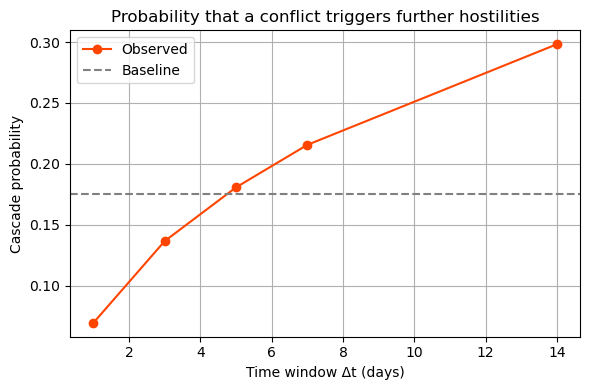
The plot below gets at something pretty close to your original question: is the hate just random venting, or does conflict actually spread from one subreddit to another?

Probability that a conflict triggers further hostilities
Figure 2
Cascade probability vs delta t

Short answer: sometimes, yes, but way less often than people assume.

What we did here was simple in spirit. Every time one subreddit links negatively to another, we watch what happens next. If the targeted subreddit later turns around and links negatively to someone else, we count that as a cascade. In other words: did getting dragged into conflict make them more likely to pass it on?

What the graph shows is that most negative links go nowhere. They’re one-off jabs, rants, or callouts that don’t trigger anything else. But not all of them. Within about five days, roughly 18% of negative links do get followed by another conflict. And if you wait longer, that number keeps creeping up.

That’s interesting on its own, but the key part is the comparison to the randomized baseline. If conflicts were just popping up randomly all over Reddit, the observed curve would sit right on top of the baseline. It doesn’t. Instead, it stays consistently above chance, no matter how wide we make the time window.

That tells us something important: being on the receiving end of a negative link actually increases the odds that a subreddit later gets involved in conflict itself.

And here’s where this connects back to “why does r/ADA get so much hate?” If a subreddit becomes a frequent target, even for legitimate reasons like difficulty, grading policies, or institutional frustration, it’s more likely to end up embedded in these small chains of negativity. Not because everyone independently decides to hate it, but because conflict has momentum.

Also worth noting: this isn’t driven by just a handful of drama hubs. Thousands of different subreddits appear as cascade starters. So it’s not just “toxic communities being toxic”, it’s a general pattern of how attention and criticism move on Reddit.

Bottom line: conflict does spread more than chance would predict, but it usually stops quickly. That makes recurring targets feel constantly under fire, even if no single conflict is that big on its own.

How Far Do Conflicts Travel?

This is where things actually get a bit reassuring.

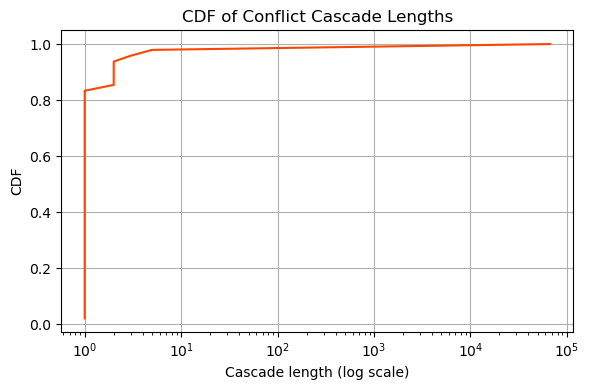
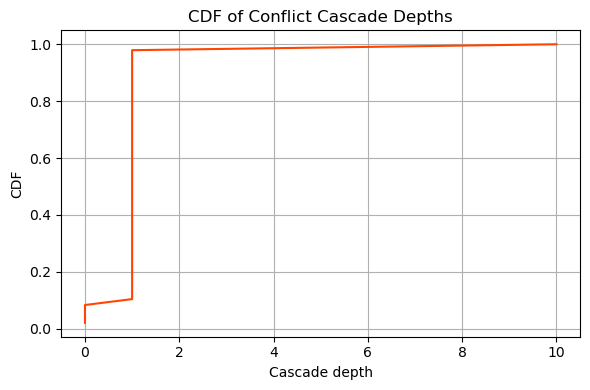
The two plots here look at how large cascades become once they start. One measures length (how many negative links total), the other measures depth (how many steps the conflict travels from one subreddit to the next).

CDF of Conflict Cascade Lengths
Figure 3
Cascade length distribution
CDF of Conflict Cascade Depths
Figure 4
Cascade depth distribution

And the story they tell is very consistent: most conflicts burn out fast.

The vast majority of cascades are tiny. One extra step. Maybe two. That’s it. In practical terms, this means a subreddit gets criticized, reacts somewhere else, and then the whole thing fizzles out. No long-running feud. No platform-wide war.

Yes, there are longer cascades. You can see the long tail in both plots. Occasionally, a conflict stays hot long enough to jump across several communities, either because it taps into something emotional, symbolic, or already controversial. These are the cases people remember, and screenshot, because they’re loud and messy.

But they’re rare.

So if it sometimes feels like “everyone is dunking on r/ADA”, this helps explain why. Not because there’s a single massive, coordinated hate campaign, but because many short-lived conflicts pile up over time, especially around visible or stressful topics. Each one is small, but together they create a persistent sense of hostility.

In other words: Reddit conflict is usually local, occasionally contagious, and only very rarely runaway.

That pattern lines up really well with what users experience day to day: lots of friction, lots of complaints, but very few situations that spiral completely out of control.

Okay, this part is actually kind of reassuring.

If most conflicts die out after one or two steps, that should mean things calm down pretty fast. But as a user, it still feels like the same subreddits get dragged over and over again.

So is that just confirmation bias on my end, or are some communities actually better at keeping this stuff alive?

Who Amplifies Conflict?

Well, it’s more complicated than that…

Up to now, we’ve mostly talked about whether conflict spreads. This section asks a slightly different question: who helps it spread the most?

Because let’s be real, not every subreddit plays the same role. Some communities occasionally stumble into conflict and move on. Others seem to show up again and again whenever things get heated.

That’s what we’re calling amplification here.

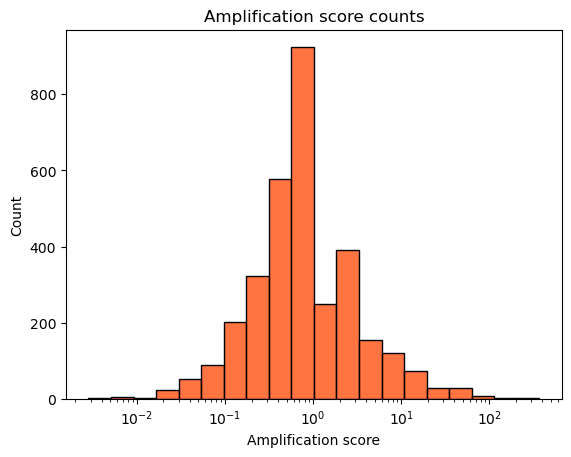
The first plot just counts how often each subreddit appears in cascades. Unsurprisingly, a few names pop up a lot. But raw counts can be misleading: big or very active subreddits are naturally going to show up more often.

Amplification Score Counts
Figure 5
Amplification Score Counts

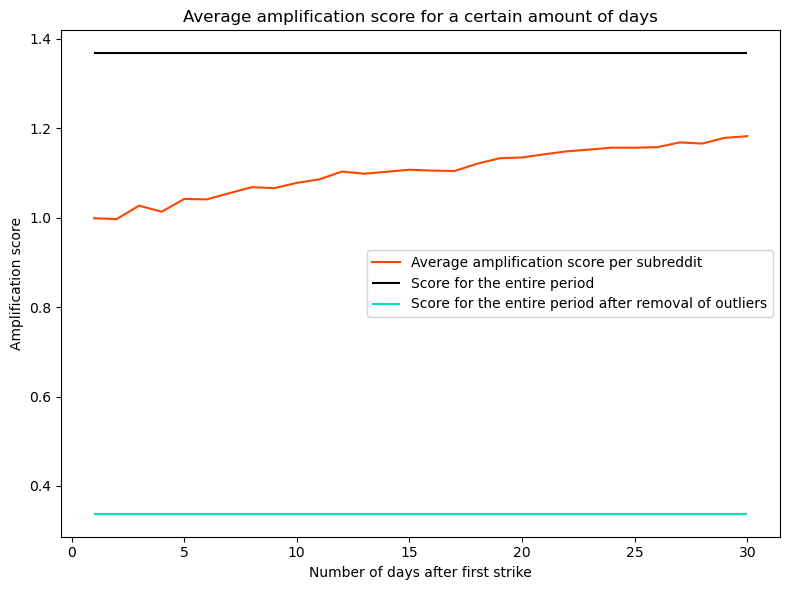
So the second plot normalizes by time, asking a fairer question: how often does a subreddit amplify conflict per day?

Average amplification score for a certain amount of days
Figure 6
Average Amplification Score for a Certain Amount of Days

What starts to emerge is a familiar pattern. A small number of communities act like repeat broadcasters. They’re not necessarily the ones starting fights, but they’re very good at keeping conflict visible, linking outward, and pulling more subreddits into the conversation.

This matters for questions like “why does it always feel like r/ADA is under fire?” If a few highly active or central communities keep resurfacing the same targets, even short-lived conflicts can stack up in people’s feeds. Over time, that creates the impression of constant hostility, even if no single conflict is especially large.

Triads, Rivalries, and the Failure of Balance

At this point, you might expect subreddit relationships to eventually stabilize.

In offline social networks, there’s a classic idea called balance theory. Very roughly, it says that triangles of relationships tend to resolve themselves into something consistent. Friends of friends usually become friends. Enemies of enemies often end up on the same side. Over time, things should feel… tidy.

So we asked: does that happen on Reddit?

To test this, we looked at triads, groups of three subreddits, and checked whether their positive and negative links form “balanced” or “unbalanced” patterns. The interactive plot below highlights where those unbalanced structures show up.

Fights in Unbalanced Triads
Figure 7 - Interactive

And honestly? The result is kind of the opposite of what balance theory would predict.

There are way more unbalanced triads than expected. Instead of resolving into clean alliances or clear rivalries, a lot of subreddit relationships stay awkward, asymmetric, or context-dependent. One subreddit might criticize another, which allies with a third, which then turns around and criticizes the first. No neat closure.

This helps explain something that often feels confusing as a user: why conflicts don’t seem to “finish.” There’s no final resolution where sides are clearly drawn and everyone moves on. Instead, relationships stay fuzzy and unstable.

A big reason for this seems to be the role of meta communities, subreddits like r/subredditdrama, r/changemyview, or r/bestof. These communities regularly link outward, often critically, without being permanently “for” or “against” anyone. They keep conflicts visible without necessarily taking part in them the same way others do.

And this connects back to the original question in an important way.

If r/ADA feels like it’s constantly being talked about, criticized here, defended there, referenced somewhere else, it’s not because it’s locked into a clean rivalry. It’s because it sits inside a web of unbalanced relationships that never quite resolve. Different communities interact with it for different reasons, in different contexts, without settling into a stable pattern.

So the takeaway here isn’t that balance theory is useless, it’s that Reddit doesn’t behave like a closed social group. Public linking, visibility, and performative criticism keep relationships fluid and unresolved.

In short: Reddit conflict doesn’t end in peace treaties or permanent enemies. It just… stays weird.

One thing I still can’t shake is how fast some of these responses feel.

When a subreddit gets criticized and then links out again almost immediately, it really looks like retaliation, like a clapback. And when the response comes way later, it feels calmer, maybe more deliberate.

Is there anything in the data that actually supports that, or is timing basically just vibes?

That’s exactly the intuition we had going in.

So we tested it in a few different ways: first by looking at how responses accumulate over time, and then by checking whether fast vs. slow responses differ in sentiment or structure.

Let’s walk through it step by step.

Timing Isn’t Everything

A natural assumption on Reddit is that speed equals intent:

  • fast response → retaliation
  • slow response → cooling off (or reconciliation)

So we tested timing as a predictor of what a targeted subreddit does next.


1) Do “follow-up conflicts” mostly happen quickly?

We start simple: after a negative link A → B, how does the probability of “B gets involved in another negative link” grow as we widen the time window?

Temporal proximity distribution
Figure 8 - Interactive

If timing were driving escalation, we’d expect a strong “front-loaded” effect (lots of meaningful action immediately, then a drop). Instead, the curve is pretty smooth: things happen, but there isn’t a clean “fast = special” boundary.

So basically: stuff happens after getting called out, but it’s not like “within 6 hours = revenge mode”?

Exactly. Next we asked the sharper version of your question: even if responses happen at different speeds, does that change what kind of response it is?


2) Are fast responses more aggressive?

Here we look at sentiment of the response relative to how quickly it happens.

Distribution of Response Types
Figure 9 - Interactive

And here’s another way to see the same thing (distribution-level view):

Alliance and Retaliation Response Times
Figure 10 - Interactive

It seems that retaliations happen slightly faster on average, a fact we can back up with a statistical analysis. But the effect is small,the distributions overlap a lot, and there’s no clear cutoff where “fast = angry” and “slow = chill.”


3) The real imbalance: alliances dominate retaliation

Once we classify what happens after a subreddit is targeted, one fact overwhelms everything else:

  • 98.3% alliances
  • 1.74% retaliation

In practice, that means most subreddits don’t “clap back” at the original source. Instead, they tend to align, redirect attention, or participate in broader coalitions.

Wait,only 1.74% is retaliation? That’s way lower than I expected. So is Reddit drama mostly just… dogpiling?

That’s the uncomfortable interpretation, yes.

And it leads to the next question: if timing doesn’t explain much, maybe content / similarity does. So we tested whether subreddits that are “close in topic space” behave differently.


4) If it’s not timing, is it similarity?

We represent each subreddit with a semantic embedding and measure how close communities are in topic space.

Density Distribution of Semantic Similarity
Figure 11 - Interactive

Then we look at whether those representations separate alliance vs retaliation outcomes:

PCA Projection of Subreddit Conflict Space
Figure 12 - Interactive

Finally, we quantify predictive performance:

ROC Curve
Figure 13 - Interactive

Putting these together: timing is weak, but similarity carries signal. Alliances are “Strategic”: Because alliances have lower similarity, they represent broad coalitions/communities from different areas of Reddit coming together against a common foe.

Retaliations are “Intra-group”: Hostility is concentrated among “neighbors.” Whether it is different factions of a gaming community or rival political subreddits, the data suggests that the most intense and immediate conflicts occur between those who are most alike. On Reddit, you are most likely to be attacked by, and retaliate against, the communities you are most similar to.

Takeaway: Reddit conflict isn’t driven by how fast people respond.
It’s driven more by who is similar, who is visible, and who repeatedly becomes a focal point.

Okay, that actually clicks.

So it’s not “they replied fast so they were mad.” It’s more like: the same cluster of related subreddits keeps aligning around the same grievances, and the visible target gets hit repeatedly.

That makes it feel personal when you’re inside it… but it’s more structural than I thought.

Takeaways

Summary

So… Why Does r/ADA Get So Much Hate?

Alright, let’s zoom out and tie all of this together.

Looking across thousands of interactions between subreddits, a pretty consistent picture emerges, and it’s a lot more nuanced than “people just like to hate.”

First, conflict on Reddit does spread. When one community publicly criticizes another, it often triggers follow-ups. Not always, but more often than random chance would suggest. So if r/ADA gets called out once, that does make it more likely to show up in later conflict elsewhere. That alone already helps explain why the criticism can feel recurring rather than isolated.

At the same time, most conflicts are small and short-lived. The majority stop after one extra step. Big, multi-subreddit blow-ups do happen, but they’re rare. What’s much more common is lots of little flare-ups that fade quickly, and over time, those add up in people’s feeds and memories.

When subreddits do respond, they almost never retaliate directly. Instead, they overwhelmingly align with others. This is why conflict on Reddit often looks like dogpiling rather than back-and-forth fighting. Timing doesn’t really matter here: fast replies aren’t angrier, slow replies aren’t calmer. What matters is who shares context, identity, or frustration.

And that’s a big piece of the r/ADA story. r/csmastudents and r/ADA don’t exist in separate worlds. They’re part of the same ecosystem. When similar communities align around shared stress, workload, grading, pressure, it creates repeated waves of criticism, even without anyone actively trying to escalate things.

Finally, these relationships don’t cleanly resolve. Reddit doesn’t settle into stable rivalries or lasting alliances. A lot of interactions stay unbalanced and unresolved, especially around visible or “meta” communities that keep resurfacing conflicts without owning them. That keeps topics alive without pushing them toward a final showdown.

So to answer the original question:

Is r/ADA hated because the class is hard?

Partly, but more importantly, because visibility, similarity, and network structure keep pulling it back into attention. Not because everyone is constantly angry at it, but because many small, short-lived conflicts keep overlapping.

Reddit isn’t dominated by giant, ongoing wars between communities. It’s shaped by lots of brief disagreements that spread through attention, reshape alignments, and then fade, until the next one pops up.

Some pieces are still open questions, like exactly which communities amplify conflict the most and how topic similarity shapes alliances. But even without those final answers, one thing is clear:

Disagreement on Reddit is frequent and public, but most of the time, it’s temporary. And what feels like “constant hate” is usually many small moments of friction adding up, not a single sustained feud.


Thanks again!

Summary

Just wanted to say thanks for taking the time to break all of this down.

I came in assuming that r/ADA was kind of stuck in a straightforward rivalry, like people were mad about the class and kept going after it. What I didn’t realize is how much of this is about visibility and similarity rather than direct hostility.

Seeing that most conflicts are short-lived, that retaliation is actually rare, and that alignment is driven by shared context really reframes the whole thing. It explains why it feels like constant hate without there being one big ongoing feud.

Honestly, this makes Reddit drama feel a lot less personal and a lot more structural. Still annoying sometimes, but easier to understand.

Appreciate the work you’re doing here, definitely sticking around this sub.